
Note: This is for educational purposes. This is not medical advice, and I am not telling you what you should do. Every person is or should be in control of their own health in spite of what the current medical establishment would like you to believe.
There is a good chance you have walked past it dozens of times without a second thought. It sits on the laundry aisle, usually near the bottom shelf, in a green and white box that has not changed much in over a century. Borax. 20 Mule Team. A few dollars for a large box that that last months when used for laundry or decades when used for health.
For most people, it is strictly a laundry booster. But informed people around the world have been quietly using small amounts of borax dissolved in water for decades, reporting improvements in joint pain, mental clarity, hormone balance, energy, and more. Conventional medicine has largely ignored these reports. Researchers, however, have not been entirely indifferent.
What has slowly emerged from government-funded animal studies and biochemistry research is a genuinely surprising picture. Borax contains boron, a trace mineral that plays a central and underappreciated role in one of your body’s most critical biological processes: methylation. Specifically, boron appears to be essential for the proper formation and utilization of SAM-e (S-adenosylmethionine), the molecule your body uses to power methylation throughout every tissue and organ. [1, 2]
If you have an MTHFR gene variant, struggle with elevated homocysteine, or have been told your methylation is impaired, this information may be more relevant to you than anything else you have read on the subject. Here is why.
What Is Methylation, and Why Does It Matter So Much?
Methylation sounds technical, but the concept is straightforward. Throughout your body, molecules constantly need to be switched on or off, built or broken down, tagged for action or tagged for removal. Methylation is the mechanism your body uses to do a large portion of that work.
A methyl group is simply a carbon atom bonded to three hydrogen atoms. When your body attaches one of these tiny tags to a molecule, it changes that molecule’s behavior. Methylation controls whether certain genes are expressed or silenced. It regulates the production and breakdown of neurotransmitters like dopamine, serotonin, and norepinephrine. It detoxifies estrogen and other hormones. It repairs DNA. It controls inflammation. It builds the myelin sheath that insulates your nerve fibers.
In short, methylation is not one process. It is thousands of processes, all dependent on a single molecule: SAM-e, which stands for S-adenosylmethionine. SAM-e is your body’s universal methyl donor. Think of it as the currency your body uses to pay for every methylation reaction. When SAM-e is abundant and functioning well, methylation runs smoothly across all of those systems. When SAM-e is depleted or poorly utilized, the entire methylation economy slows down. [3]
The consequences of inadequate methylation are wide-ranging and serious. Homocysteine, a toxic amino acid that your body normally recycles quickly, builds up in the blood and damages blood vessels. Neurotransmitter synthesis falters, contributing to depression, anxiety, and brain fog. Hormone clearance slows. DNA repair becomes less efficient. Inflammation rises. The body essentially loses its ability to regulate itself with precision. [3]
The MTHFR Connection: A Gene That Millions of People Carry
In the past two decades, a genetic variant called MTHFR has gotten a great deal of attention in integrative medicine circles. MTHFR stands for methylenetetrahydrofolate reductase, which is the enzyme that converts folate (vitamin B9) from its dietary form into its active, usable form called 5-methyltetrahydrofolate, or 5-MTHF.
This active folate is essential for the process that recycles homocysteine back into methionine. And methionine is the direct precursor to SAM-e. So when MTHFR is not working properly, the whole chain suffers: less active folate means less methionine recycled, which means less SAM-e produced, which means weaker methylation across the board.
There are two primary MTHFR variants that researchers have studied most extensively. The C677T variant reduces enzyme function by 30 to 40 percent in people who carry one copy and by 60 to 70 percent in people who carry two copies. The A1298C variant reduces methyl folate production by approximately 17 percent. Depending on the study, these variants collectively affect somewhere between 40 and 60 percent of the general population in some form. [4, 5]
The standard clinical response to MTHFR variants is to supplement with methylfolate (the active form of folate that bypasses the MTHFR step) along with methylcobalamin (active B12), which is needed for the same homocysteine recycling reaction. This approach is genuinely helpful for many people. But it addresses only one bottleneck in the methylation system, specifically the step where folate feeds into the cycle. What happens after methionine is made and SAM-e is produced is a separate matter entirely. [6]
That is where boron enters the picture.
The Ribose Ester Chemistry: How Boron Interacts with SAM-e
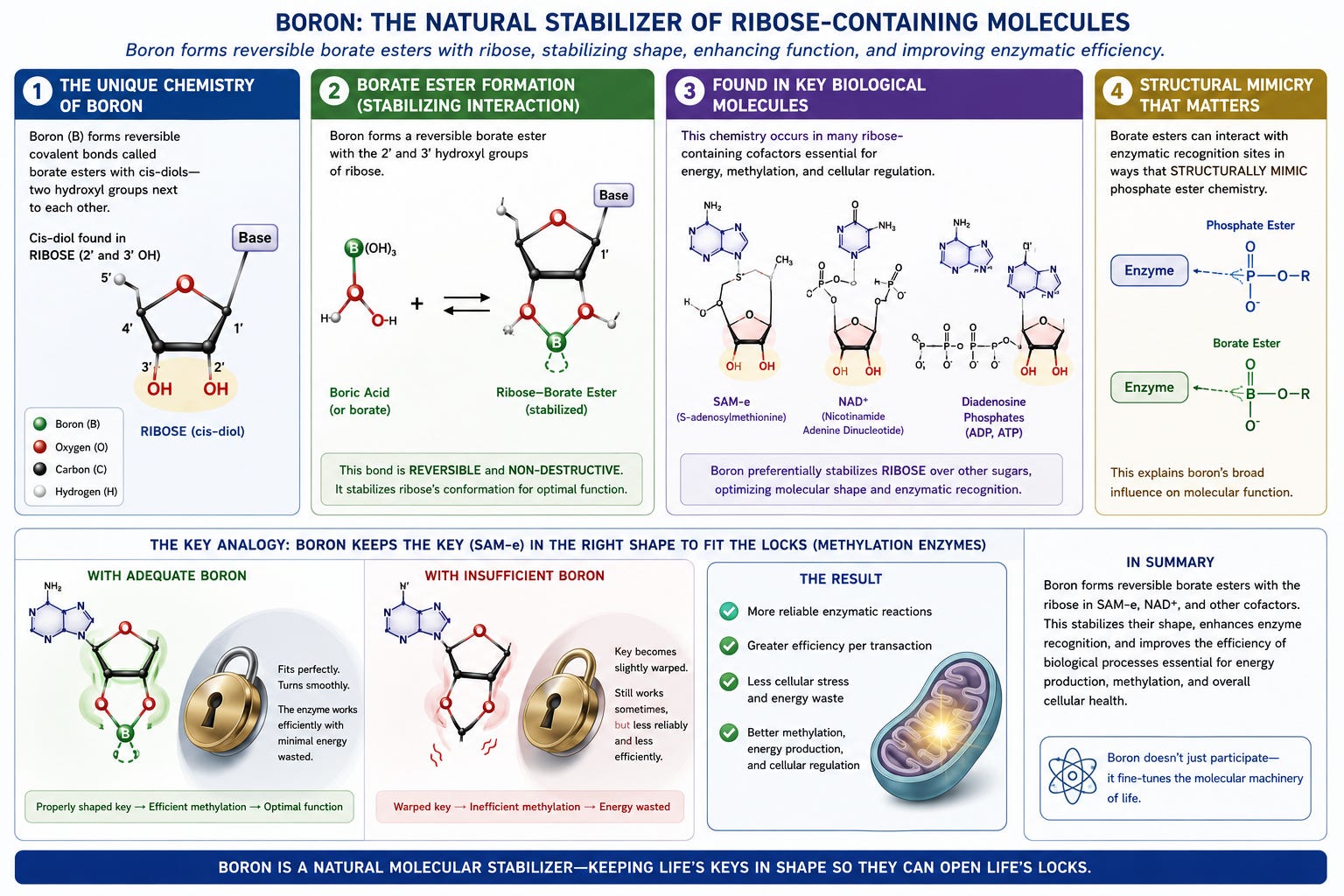
Boron has a unique chemical property that most minerals do not share. It forms reversible covalent bonds, called borate esters, with molecules that contain a specific structural feature: two hydroxyl groups positioned next to each other on a ring-shaped sugar. This configuration is called a cis-diol, and it appears in ribose, the five-carbon sugar built into a wide range of biologically critical molecules. [1, 7, 8]
SAM-e is one of those molecules. SAM-e is constructed around an adenosine scaffold, and adenosine contains ribose. When boron is present at adequate levels in the body, it can form a borate ester with the 2’ and 3’ hydroxyl groups of the ribose portion of SAM-e. This interaction is not destructive. It is stabilizing. Research has confirmed that borate preferentially stabilizes ribose over other sugars, altering the molecule’s conformation and influencing how efficiently enzymatic reactions can utilize it. The same borate ester chemistry applies to other ribose-containing cofactors central to energy and cellular regulation, including NAD+ (the electron carrier essential for cellular energy production) and diadenosine phosphates. [1, 7, 8]
A useful analogy: imagine SAM-e as a key and the methylation enzymes as locks. Boron helps keep the key properly shaped so it fits cleanly into the locks. Without enough boron, the key becomes slightly warped. It still works sometimes, but less reliably, less efficiently, and with more energy wasted per transaction. Research on borate-nucleoside complexes has confirmed that borate esters can interact with enzymatic recognition sites in ways that structurally mimic phosphate ester chemistry, a finding that helps explain boron’s broad influence on molecular function. [9]
This is why boron’s influence on biochemistry is so broad: it is not targeting one reaction. It is interacting with a structural feature shared across some of the most important molecules in human metabolism.
Boron Deficiency as a Methylation Phenocopy
Here is where the story becomes genuinely remarkable.
Researchers at the USDA Grand Forks Human Nutrition Research Center conducted controlled animal deprivation studies in which rats were fed carefully controlled diets extremely low in boron. The results were striking. The boron-deprived animals developed an almost exact biochemical mirror image of MTHFR dysfunction. Their liver SAM-e levels fell significantly. Their S-adenosylhomocysteine (SAH), the product formed after SAM-e donates a methyl group, also dropped, confirming that the entire methyl-donation cycle was slowing down. Spermidine, a polyamine that depends on decarboxylated SAM-e for its synthesis, decreased as well. And plasma homocysteine rose, which is the single most important clinical marker of impaired methylation. [10]
A companion study further established that boron deprivation increases plasma homocysteine specifically as a factor negatively associated with bone composition and strength, reinforcing that this is a systemic effect with real tissue consequences, not just a laboratory number. [11]
In genetics, there is a term for this: a phenocopy. A phenocopy is what happens when an environmental condition produces the same observable symptoms or biochemical profile as a genetic mutation, without actually changing the gene. The MTHFR gene in those boron-deprived rats was completely intact. Their enzyme was functional. But the downstream methylation system looked nearly identical to what you see in animals or humans with a significant MTHFR impairment. [10, 11]
This has a profound implication for how we think about methylation problems. It means that boron deficiency alone, without any genetic variant, can produce the full clinical picture of methylation insufficiency. And it means that someone carrying an MTHFR variant who is also boron-deficient is experiencing both problems simultaneously, with effects that compound each other.
The USDA researchers also found that oxidative stress dramatically amplified the methylation consequences of boron deficiency. This is critically important, because chronic inflammation and oxidative stress are already common in the populations most likely to be seeking answers about MTHFR and methylation.[10, 11, 12]
The Compounding Problem: When Genetics, Nutrition, and Inflammation Collide
Think of your methylation capacity as a bucket. When the bucket is full, the system runs smoothly. Each of the following factors puts a hole in that bucket.
An MTHFR C677T heterozygous variant puts a moderate-sized hole in the bottom. You lose 30 to 40 percent of the folate conversion capacity that feeds SAM-e production. That alone may not be enough to cause serious problems for many people, especially with a good diet and adequate supplementation. [4]
Boron deficiency punches another hole. Now SAM-e is not only being produced more slowly, it is also being utilized less efficiently at the molecular level due to impaired borate ester formation on the ribose backbone. The bucket is draining faster.[1, 10]
Chronic inflammation, poor sleep, a high-sugar diet, alcohol consumption, and gut dysbiosis each add additional strain. A study examining the ratio of SAM to SAH, known as the methylation potential, found that disruption of methyl cycle function has cascading effects on gene expression, neurotransmitter regulation, and circadian rhythm, confirming that methylation insufficiency is rarely isolated to one symptom domain. [3]
At some point, a person who might have lived their entire life without a single methylation symptom, despite carrying an MTHFR variant, reaches a threshold where the combined load becomes clinically significant. This is likely why so many people with MTHFR variants feel perfectly fine until a period of high stress, illness, or dietary change, and then suddenly develop fatigue, anxiety, brain fog, or elevated homocysteine that seems to come from nowhere.
Correcting boron deficiency is the most accessible and least expensive of these interventions. It does not change your genetics. It does not fully replace the need for methylfolate and B12 in people with significant MTHFR variants. But it removes one of the most correctable contributors to the problem, and given its central role in SAM-e utilization, the benefits could be disproportionately large relative to the effort required.[1, 2]
What Boron Deficiency Actually Looks Like
Because boron is not on any standard laboratory deficiency panel and has no established dietary reference intake in the United States, most people have never considered whether they might be low in it. Yet the conditions under which deficiency develops are extraordinarily common.
Boron is found primarily in plant foods: fruits, vegetables, nuts, and legumes. A diet centered on processed foods, refined grains, and animal products with minimal plant variety delivers very little boron. The diverse physiologic consequences of boron deprivation in animals include altered brain electrical activity, impaired immune function, reduced bone strength, disrupted hormone metabolism, and elevated homocysteine, all of which are consistent with widespread SAM-e insufficiency. [1, 2, 13]
The symptoms of boron deficiency, viewed through the lens of impaired methylation, look like this: persistent brain fog, difficulty with short-term memory, poor concentration, depression or low mood, fatigue that does not resolve with rest, joint pain and stiffness, hormone imbalances (particularly low testosterone or estrogen dysregulation), elevated homocysteine on blood tests, and a general sense of cognitive and physical dullness that nothing seems to fix completely. [1, 2, 13]
These are also, not coincidentally, common complaints among people who have been diagnosed with MTHFR variants or are being evaluated for dysautonomia, fibromyalgia, or chronic fatigue. The overlap is not coincidental. It reflects the central role of methylation in neurological, hormonal, and inflammatory regulation.[1, 4]
Is Borax Safe?
This is the question that makes most conventionally trained practitioners uncomfortable, so it deserves a careful and thorough answer. Full answer in this article.
Consuming Borax Is Safe — Consuming the Wrong Dose May Not Be

Note: This is for educational purposes. This is not medical advice, and I am not telling you what you should do. Every person is or should be in control of their own health in spite of what the current medical establishment would like you to believe. If you feel that you need medical advice, you should consult with a well informed open-minded health pra…
Borax is sodium tetraborate, a naturally occurring mineral salt. The toxicology of boron compounds has been formally evaluated, and the genotoxicity studies collectively indicate that boron-containing compounds are not genotoxic. There was no evidence of carcinogenicity in a two-year animal study. The doses used in the USDA boron research ranged from approximately 3 to 10 mg of elemental boron per day, which is within the range of what populations consuming high amounts of fruits, vegetables, and nuts obtain through diet alone. Many human and animal trace mineral intake studies use sodium tetraborate (Borax) directly due to its known safety profile. [1, 2, 13, 14]
Human clinical trials using supplemental boron, primarily in the form of borax, have used doses ranging from 6 to 11.6 mg elemental boron per day. For example, a double-blind, placebo-controlled trial found that 6 mg per day of supplemental boron (as borax) produced favorable outcomes in 50 percent of osteoarthritis subjects, compared to only 10 percent in the placebo group. Acute supplementation at 11.6 mg produced significant reductions in high-sensitivity C-reactive protein (hs-CRP) and tumor necrosis factor-alpha (TNF-alpha) within 6 hours in healthy male volunteers. [1]
Curious Note:
High hs-CRP is a sign of inflammation.
High TNF-alpha generally means your immune system is in a pro‑inflammatory, “switched on” state, often due to infection, chronic inflammation, or autoimmune disease.
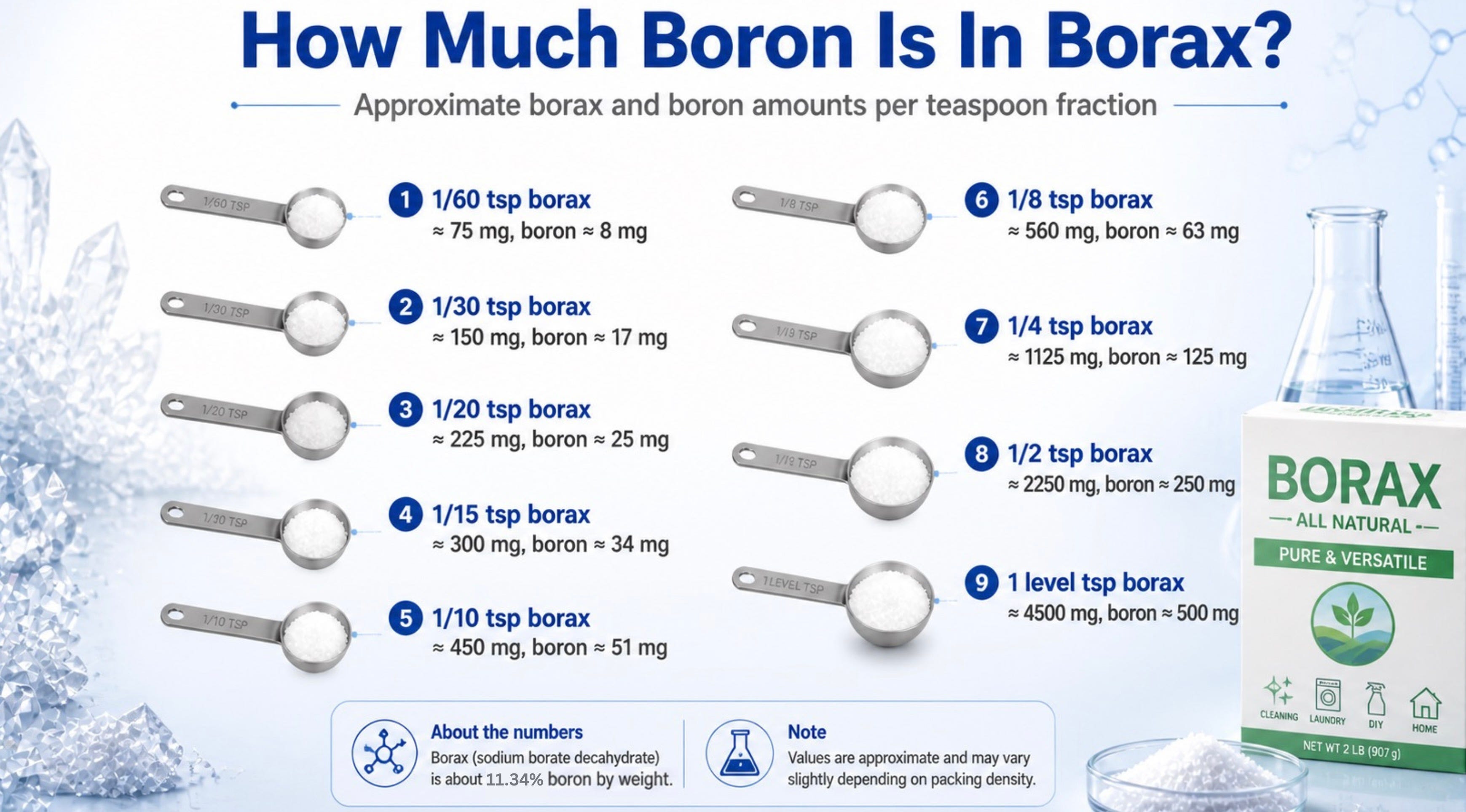
To achieve approximately 10 mg of elemental boron from borax, roughly 88 mg of borax is required, a very small amount that can be dissolved in water, coffee, or any beverage and consumed gradually throughout the day. This is not a megadose. It is in the nutritional range studied by the USDA.
Practical Takeaways: Food, Supplements, and Borax
If you want to improve your boron status through food first, the best sources are: almonds, avocados, prunes, raisins, dried apricots, chickpeas, kidney beans, and most other legumes. Adding a handful of almonds and half an avocado to your daily diet, alongside generous servings of legumes and fruit, can reasonably raise your boron intake.[2]
For supplemental boron, several products are available in capsule form using boron glycinate, sodium borate, or calcium fructoborate (the naturally occurring plant form). These typically deliver 3 to 6 mg per capsule and are widely available at reasonable cost.
Borax itself, dissolved in small amounts in water, represents the most economical option. A optimal approach involves dissolving a small amount of borax in a liquid and drinking that solution slowly throughout the day, staying within the 3 to 10 mg elemental boron range that was studied in the USDA deprivation research. [10, 11]
Here is a simple graphic that you can download save. The graphic shows you how much boron is in a given amount of borax.
For people managing MTHFR variants specifically, boron is not a replacement for methylfolate, B12, or riboflavin (which stabilizes the MTHFR enzyme itself). Think of it as an addition to those foundations, one that addresses a different and largely overlooked part of the methylation system. [1, 5, 6, 10]
The human clinical trial data on boron and methylation is still limited. Most of the compelling evidence comes from the USDA animal deprivation studies and biochemical mechanistic research. The mechanistic plausibility grounded in solid peer-reviewed research, combined with an exceptional safety profile and negligible cost, makes boron a reasonable and underexplored addition to any serious methylation support protocol. [1, 2, 10]
Sometimes the most interesting things really do come from the most unexpected places. Even the laundry aisle.
If you have personal experience using boron or borax as part of a health protocol, I would love to hear what you have observed. Leave a comment below or reply to this post. And if you are not yet subscribed, joining is free and keeps this kind of research-driven content coming directly to you.
Blessings in Jesus name,
The Curious Outlier
References
1. Pizzorno, L. (2015). Nothing boring about boron. *Integrative Medicine: A Clinician’s Journal, 14*(4), 35–48. https://pmc.ncbi.nlm.nih.gov/articles/PMC4712861/
2. Nielsen, F. H. (2008). Is boron nutritionally relevant? *Nutrition Reviews, 66*(4), 183–191. https://pubmed.ncbi.nlm.nih.gov/18366532/
(Here is the full article. The site where it is located is on a server of a friend. Even though it says it’s not secure it’s not harmful)
3. Fustin JM, et al. Methylation deficiency disrupts biological rhythms from bacteria to humans. Commun Biol. 2020 May 6;3(1):211. https://pmc.ncbi.nlm.nih.gov/articles/PMC7203018/
4. Blom HJ, Smulders Y. Overview of homocysteine and folate metabolism. With special references to cardiovascular disease and neural tube defects. J Inherit Metab Dis. 2011 Feb;34(1):75-81. https://pmc.ncbi.nlm.nih.gov/articles/PMC3026708/
5. Araszkiewicz AF, et al. MTHFR Gene Polymorphisms: A Single Gene with Wide-Ranging Clinical Implications-A Review. Genes (Basel). 2025 Apr 8;16(4):441. https://pmc.ncbi.nlm.nih.gov/articles/PMC12027316/
6. Greenberg, J. A., Bell, S. J., Guan, Y., & Yu, Y. H. (2011). Folic acid supplementation and pregnancy: More than just neural tube defect prevention. Reviews in Obstetrics and Gynecology, 4 (2), 52–59. https://pmc.ncbi.nlm.nih.gov/articles/PMC3218540/
7. Loomis, W. D., & Durst, R. W. (1992). Chemistry and biology of boron. BioFactors, 3(4), 229–239. https://pubmed.ncbi.nlm.nih.gov/1605832/
8. Furukawa Y, Horiuchi M, Kakegawa T. Selective stabilization of ribose by borate. Orig Life Evol Biosph. 2013 Oct;43(4-5):353-61. Full PDF Article
9. Gabel SA, London RE. Ternary borate-nucleoside complex stabilization by ribonuclease A demonstrates phosphate mimicry. J Biol Inorg Chem. 2008 Feb;13(2):207-17. https://pubmed.ncbi.nlm.nih.gov/17957392/
10. Nielsen FH. Boron deprivation decreases liver S-adenosylmethionine and spermidine and increases plasma homocysteine and cysteine in rats. J Trace Elem Med Biol. 2009;23(3):204-13. https://pubmed.ncbi.nlm.nih.gov/19486830/
11. Nielsen, F.H. (2007), Boron deprivation increases plasma homocysteine, a factor negatively associated with bone composition and strength. The FASEB Journal, 21: A125-A125. https://doi.org/10.1096/fasebj.21.5.A125-b
12. Nielsen, Forrest & Meacham, Susan. (2011). Growing Evidence for Human Health Benefits of Boron. Complementary Health Practice Review. 16. 169-180. 10.1177/2156587211407638. Full PDF Article
13. Nielsen FH. Biochemical and physiologic consequences of boron deprivation in humans. Environ Health Perspect. 1994 Nov;102 Suppl 7(Suppl 7):59-63. https://pmc.ncbi.nlm.nih.gov/articles/PMC1566640/
14. Hadrup N, Frederiksen M, Sharma AK. Toxicity of boric acid, borax and other boron containing compounds: A review. Regul Toxicol Pharmacol. 2021 Apr;121:104873. https://pubmed.ncbi.nlm.nih.gov/33485927/
I've been using and ingesting borax for many years now. I wasn't sick to begin with, just trying to maintain my good health.
I sprinkle a "dash" in my glass of drinking water every few days to kill any parasites or morgellons I might have.
I add 1/2 cup Borax to my washing machine with laundry detergent.
I use it to wash dishes as it rinses off clean, about 1/2 cup per sink of water
I add a few tablespoons Borax and some other ingredients to a hot foot bath.
Hulda Clark's book, "The Cure for all Diseases" mentions it and I've been using it since I read her book.
Had my daily Borax enhanced coffee a few hours ago. Thanks always for your information.